


Ocean Exploration Facts
The ocean exploration facts in this section provide short answers to common or intriguing ocean questions. The questions are organized in a series of categories; click on a category to learn more about these topics.
For many ocean exploration facts, content has been repurposed from essays posted elsewhere on the website; to access the original content, click on links available on individual ocean fact pages.

Sea spiders are not actually spiders.

The Arctic Ocean, with a total area of about 14 million square kilometers (5.4 million square miles), is the world’s smallest ocean basin.
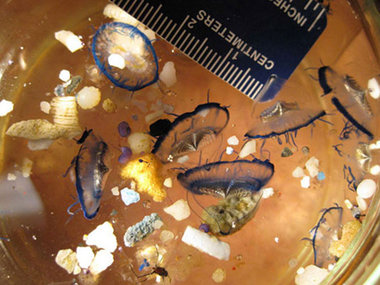
The 'Great Pacific Garbage Patch' is the popular name for an area in the North Pacific Ocean, between Hawaii and California, containing a high concentration of marine debris.

Studying shipwrecks can help us understand the past, connect us to our cultural heritage, and teach us lessons on how the environment and human error can impact each other.

The “Ring of Fire” is a string of underwater volcanoes and earthquake sites around the edges of the Pacific Ocean.

Marine snow is mostly biological debris that originates from the top layers of the ocean and drifts to the seafloor, providing a primary source of energy for animals in the deep ocean.

Marine organisms produce over half of the oxygen that land animals currently need to breathe.

The ocean is vast, yet only a tiny fraction has been explored.

Organisms living in the deep ocean must be adapted to survive under extreme pressure, limited light, cold temperatures, and other factors.

Light in the ocean decreases with depth, with minimal light penetrating between 200-1,000 meters (656-3,280 feet) and depths below 1,000 meters receiving no light from the surface.

The deep ocean is generally defined as the depth at which light begins to dwindle, typically around 200 meters (656 feet).

Scientifically, El Niño refers to unusual sea surface temperatures throughout the equatorial Pacific that result in worldwide weather effects.