2024 Fieldwork Summary
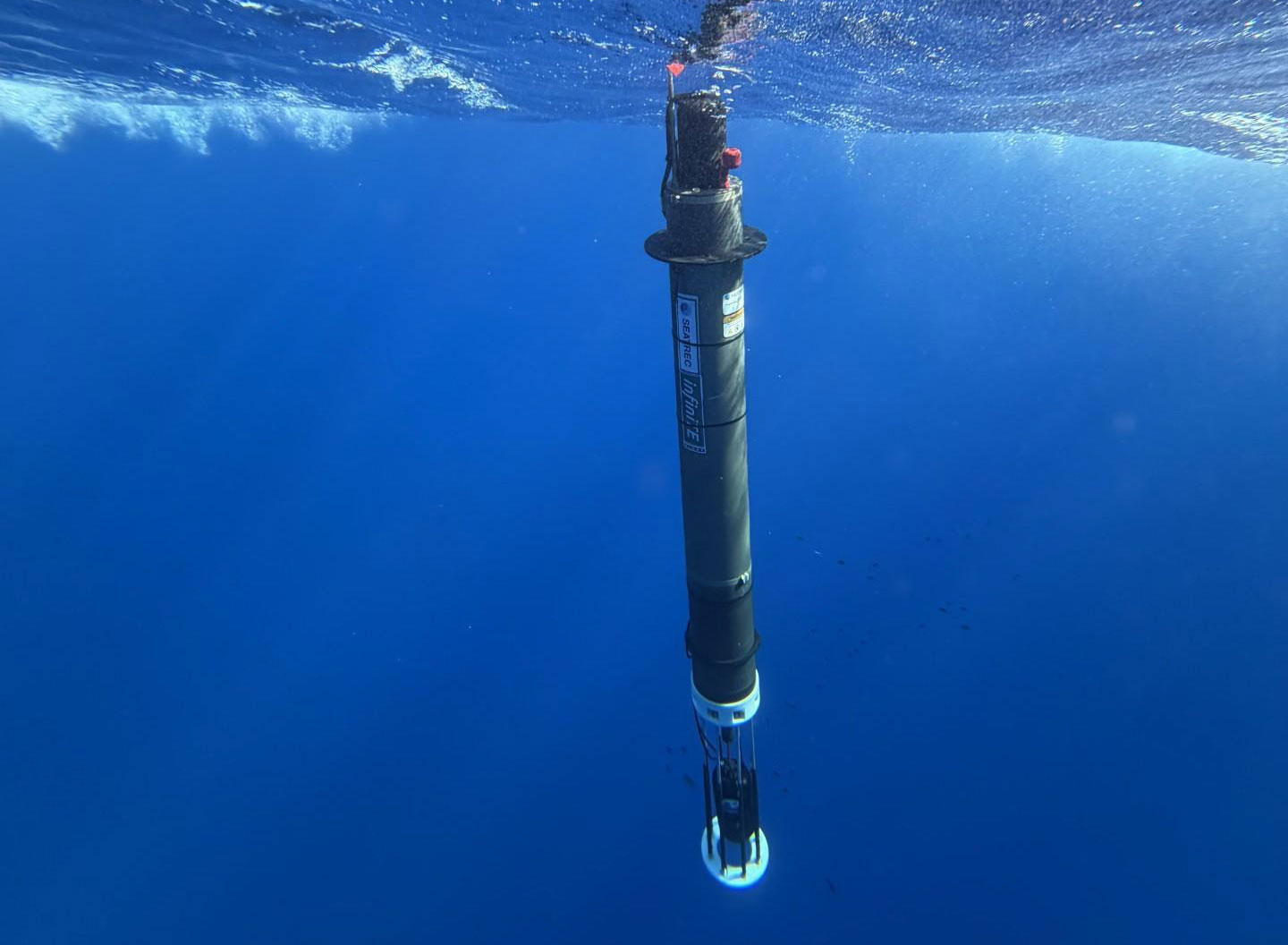
From September 23-27, 2024, the team of scientists and engineers deployed their Seatrec infiniTE float with directional acoustic sensor for its first field test off the coast of Oceanside, California.
Preparing to Deploy

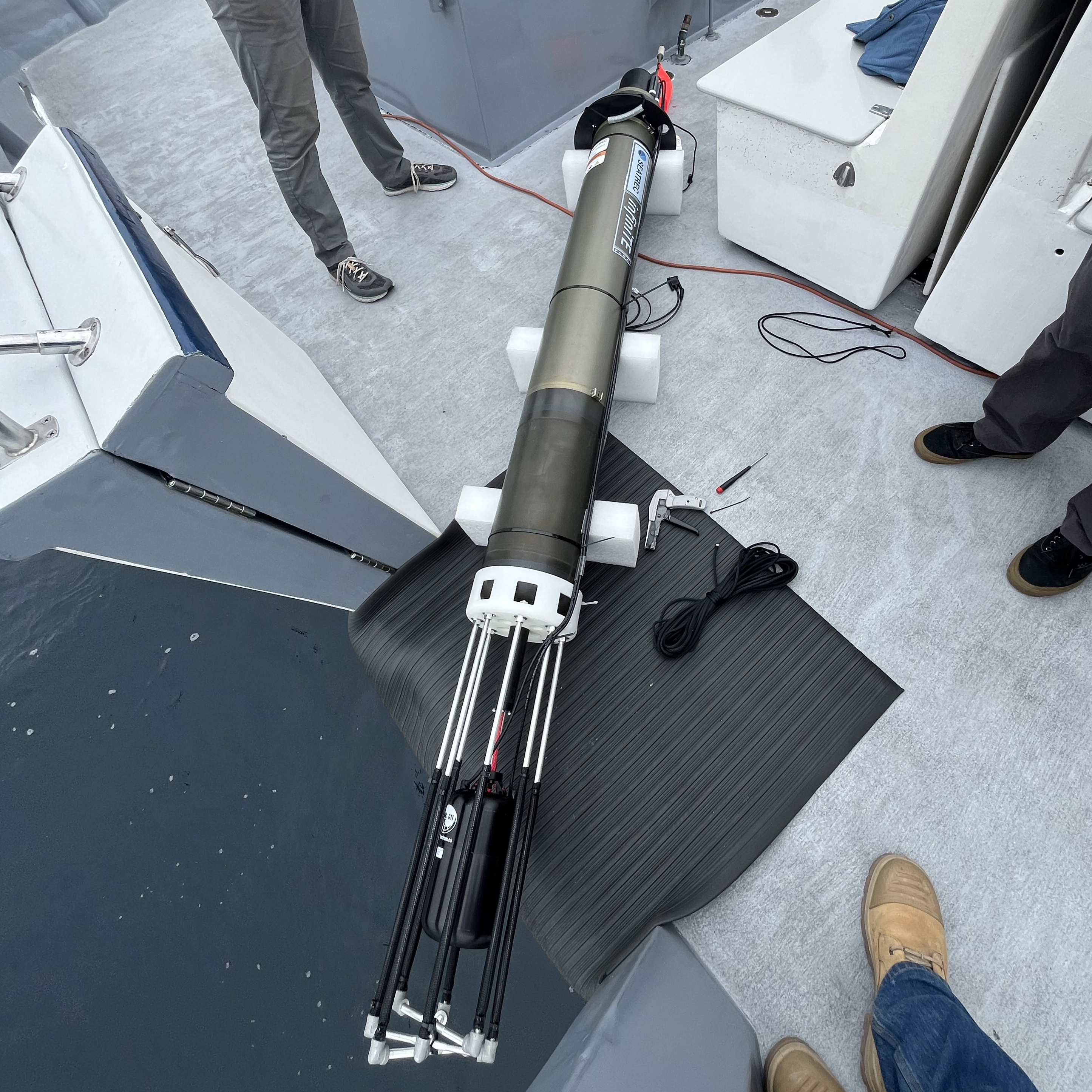
Seatrec Vice President of Engineering, Michael Zedelmair assembling the sensor mount for the float prior to its deployment in 2024 as part of the Autonomous, Directional Acoustic Profiling Float for Soundscape Characterization project. Image courtesy of Autonomous, Directional Acoustic Profiling Float for Soundscape Characterization. Download largest version (jpg, 2.96 MB).

Seatrec Engineer Josh Laney conducting the final ballast test of the float prior to its deployment as part of the Autonomous, Directional Acoustic Profiling Float for Soundscape Characterization project. Image courtesy of Autonomous, Directional Acoustic Profiling Float for Soundscape Characterization. Download largest version (jpg, 4.76 MB).
In preparation for this deployment, they designed and developed a mount to suspend the sensor below the float body. To accommodate for this added weight and ensure the appropriate amount of buoyancy, they introduced additional volume by extending the length of the float at the top. To capture data from the sensor, they also designed and developed a data logger and built a mount to hold the data logger and its battery pack inside the float.
Before heading out to sea, they conducted a final system integration at the Seatrec office in Vista, California. This included testing the final ballast test to ensure that the float buoyancy engine could accommodate the additional weight from the sensor and its mount, testing the communications system to ensure the satellite communications link was functional, connecting the data logger battery and external sensor connectors to the data logger, and a conducting a full test of the float with the sensor connected to make sure everything was in working order.
Testing the Float

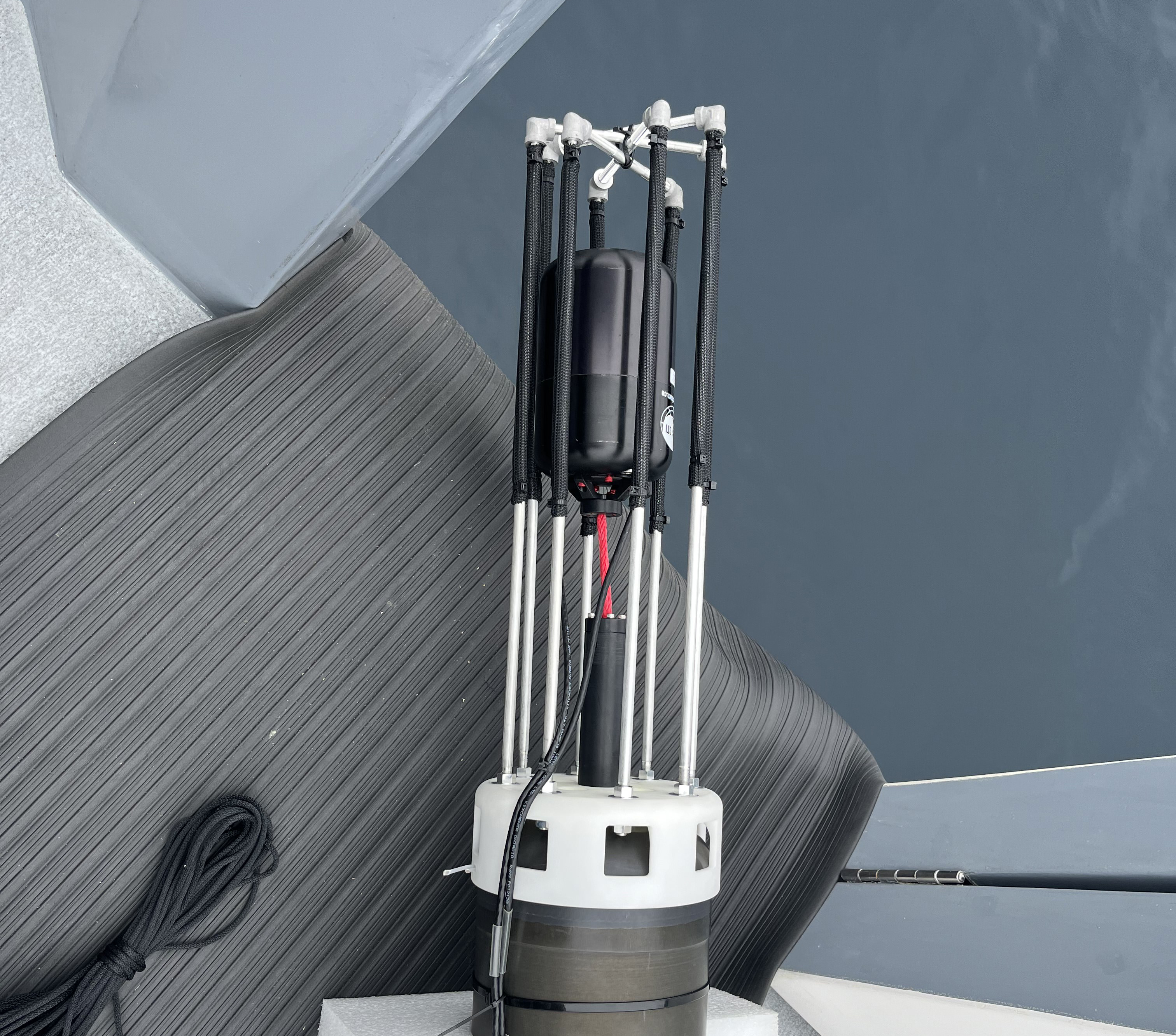
The lower portion of the float with the directional sensor, prior to its deployment in 2024 as part of the Autonomous, Directional Acoustic Profiling Float for Soundscape Characterization project. Image courtesy of Autonomous, Directional Acoustic Profiling Float for Soundscape Characterization. Download largest version (jpg, 3.7 MB).

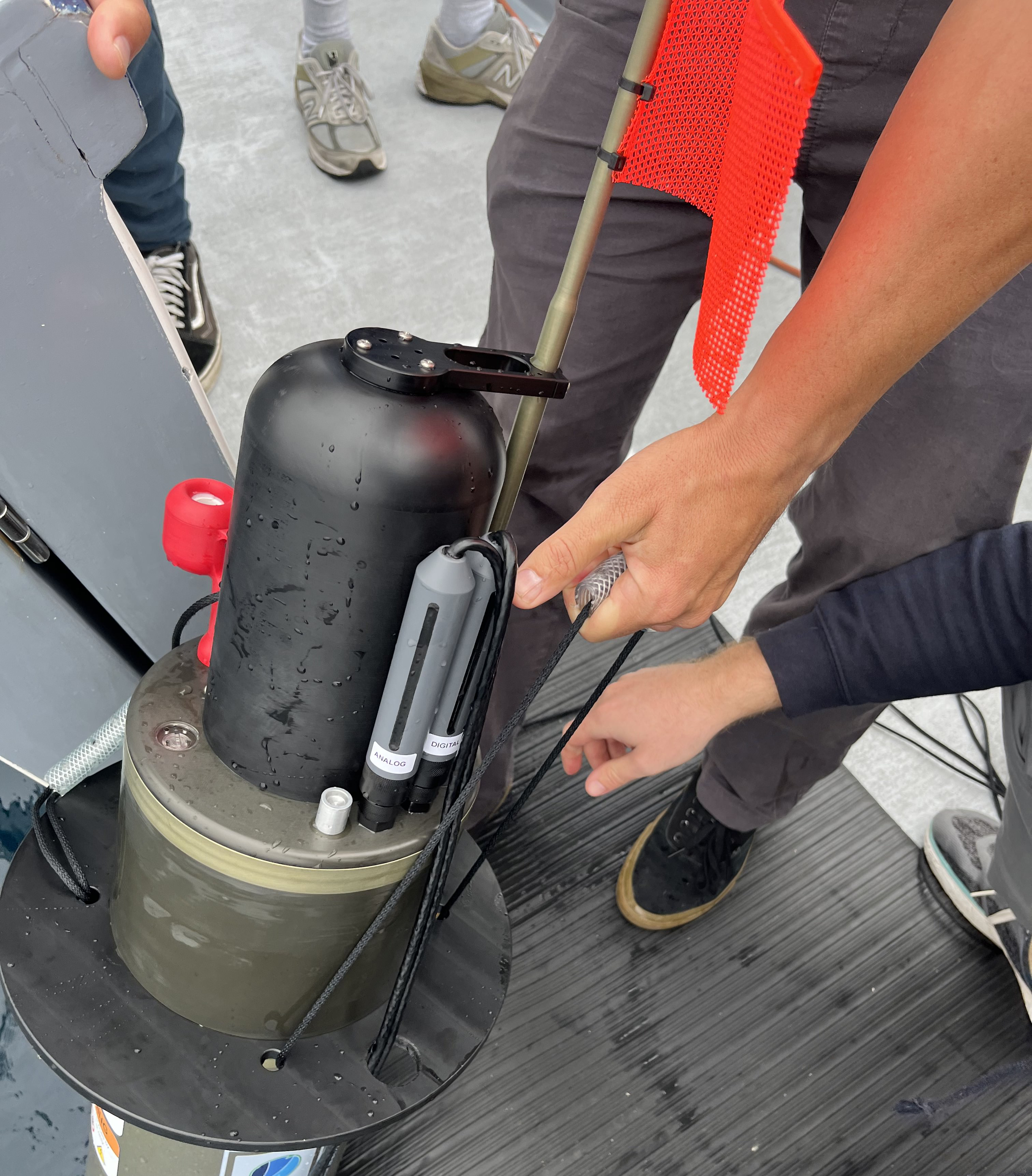
The upper portion of the float, prior to its deployment in 2024 as part of the Autonomous, Directional Acoustic Profiling Float for Soundscape Characterization project. Seen here are the buoyancy bladder (black), CTD (conductivity, temperature, depth instrument, in red), sensor connectors (gray), and satellite telemetry antenna (with flag). Image courtesy of Autonomous, Directional Acoustic Profiling Float for Soundscape Characterization. Download largest version (jpg, 3.09 MB).
On July 26, they successfully deployed and tested the float at sea for the first time for three 8-hour-long dives down to approximately 400 meters (1,312 feet), where it remained “parked” for several hours. After surfacing and relaying its position to the ship via the satellite telemetry link, it was recovered by the team.
They collected approximately 24 hours of uninterrupted directional acoustic data throughout the float operations, including diving and parking at depth.

Representation of a full 24 hours of data from the float deployed in 2024 as part of the Autonomous, Directional Acoustic Profiling Float for Soundscape Characterization project. From top to bottom: spectrogram (i.e., time-frequency representation of data), azimuth angles to sources of sound, and the float dive depth and displacement volume. Periods when the float surfaced were characterized by high ambient noise from winds and waves, while the highest quality data was captured when the float was parked at depth. Image courtesy of Autonomous, Directional Acoustic Profiling Float for Soundscape Characterization.
Download largest version (jpg, 463 KB).
Most of the data represented ambient noise, but the occasional boat sound was also captured. The quantity and quality of the data collected was enough to meet the goals of this field test. Thus, no further deployments were conducted.
Examples of acoustic data processing from the 2024 demonstration conducted as part of the Autonomous, Directional Acoustic Profiling Float for Soundscape Characterization project. Panels on the left show an example of boat noise at ~3:30 a.m. PT, while those on the right show helicopter sounds at 9:58 a.m. PT (both on July 27, 2024). The upper panels are spectrograms (i.e., time-frequency representation of data), the lower panels show horizontal bearing angles to sources of sound. The azimuth angle representation of data can only be obtained using directional acoustic sensors. Audio clips were truncated to cut out ambient noise. Images and audio clips courtesy of Autonomous, Directional Acoustic Profiling Float for Soundscape Characterization.
Next Steps
This was just the first of two tests planned as part of this project. It paves the way for a longer duration, deeper water test, currently scheduled for summer 2025. Until then the team will:
- Use data from this deployment to help develop onboard processing algorithms.
- Refine the float controls to incorporate data logger controls.
- Enable time synchronization between the float and the data logger.
- Refine the data logger communications to be able to request specific data segments from the data logger in order to process them for telemetry.
- Implement efficient onboard processing for telemetry.
- Develop a deepwater mission based on the energy requirements of the directional acoustic sensor and associated electronics.
This test was likely the first time that directional acoustic data was collected at such depth using an autonomous profiling float. Ultimately, the team hopes this float will enable deepwater exploration of ocean soundscapes in difficult to reach regions of the global ocean.
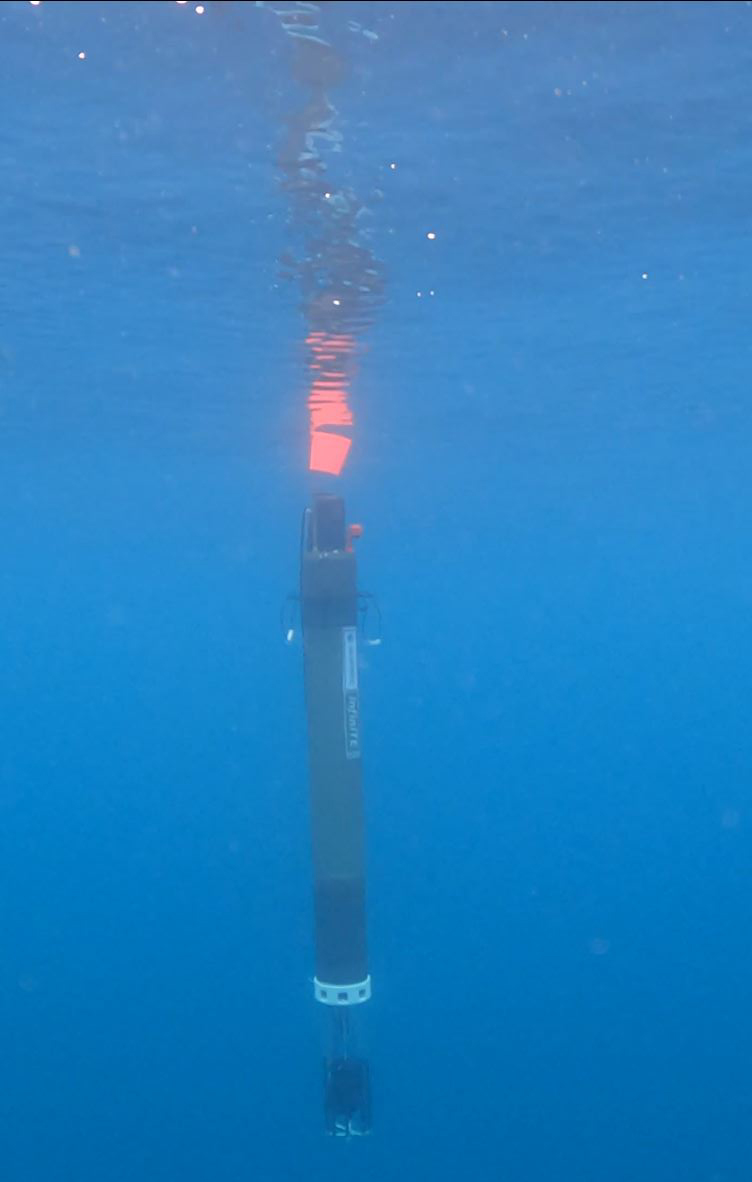
The Seatrec infiniTE float with directional acoustic sensor after its deployment for testing as part of the Autonomous, Directional Acoustic Profiling Float for Soundscape Characterization project in 2024. Image courtesy of Autonomous, Directional Acoustic Profiling Float for Soundscape Characterization. Download largest version (jpg, 194 KB).
2026 Fieldwork Summary
In the final phase of the Autonomous, Directional Acoustic Profiling Float for Soundscape Characterization project, the team conducted a two-week demonstration of their soundscape characterization tool off Kailua-Kona, Hawai‘i, in February/March 2026. During this successful demonstration, they showed that the Seatrec infiniTE float with directional acoustic sensor was able to collect acoustic data over an extended period while fully powered by an ocean thermal energy conversion (OTEC) system.
The first ocean test of the float was conducted off Oceanside, California, in September 2024. Since then, the team made a number of system improvements, significantly improving the float’s capabilities. This included refining the data logger and fully integrating the OTEC system, which removed the traditional limitations on float operations associated with battery life. Following multiple bench and tank tests and another field test off Oceanside in January 2026, the float was ready for its final demonstration — the two week mission off Hawai‘i.

The Seatrec infiniTE float with directional acoustic sensor after its deployment for the final demonstration off Hawai‘i in 2026 as part of the Autonomous, Directional Acoustic Profiling Float for Soundscape Characterization project. Image courtesy of Michael Zedelmair, Seatrec. Download largest version (jpg, 119 KB).

The lower portion of the float showing the directional sensor inside its updated, custom cage during the Autonomous, Directional Acoustic Profiling Float for Soundscape Characterization project’s January 2026 field test. Image courtesy of Emily Barosin, Integral Consulting. Download largest version (jpg, 221 KB).
The Mission
The intent of the mission was for the float to operate largely autonomously over a two-week period, conducting multiple dives to a targeted depth and collecting acoustic data for a set amount of time.

Map of the location of the final at-sea deployment and demonstration of the Seatrec infiniTE float with directional acoustic sensor showing the points of deployment and recovery as well as the points of data telemetry. Image courtesy of Autonomous, Directional Acoustic Profiling Float for Soundscape Characterization. Download largest version (jpg, 112 KB).
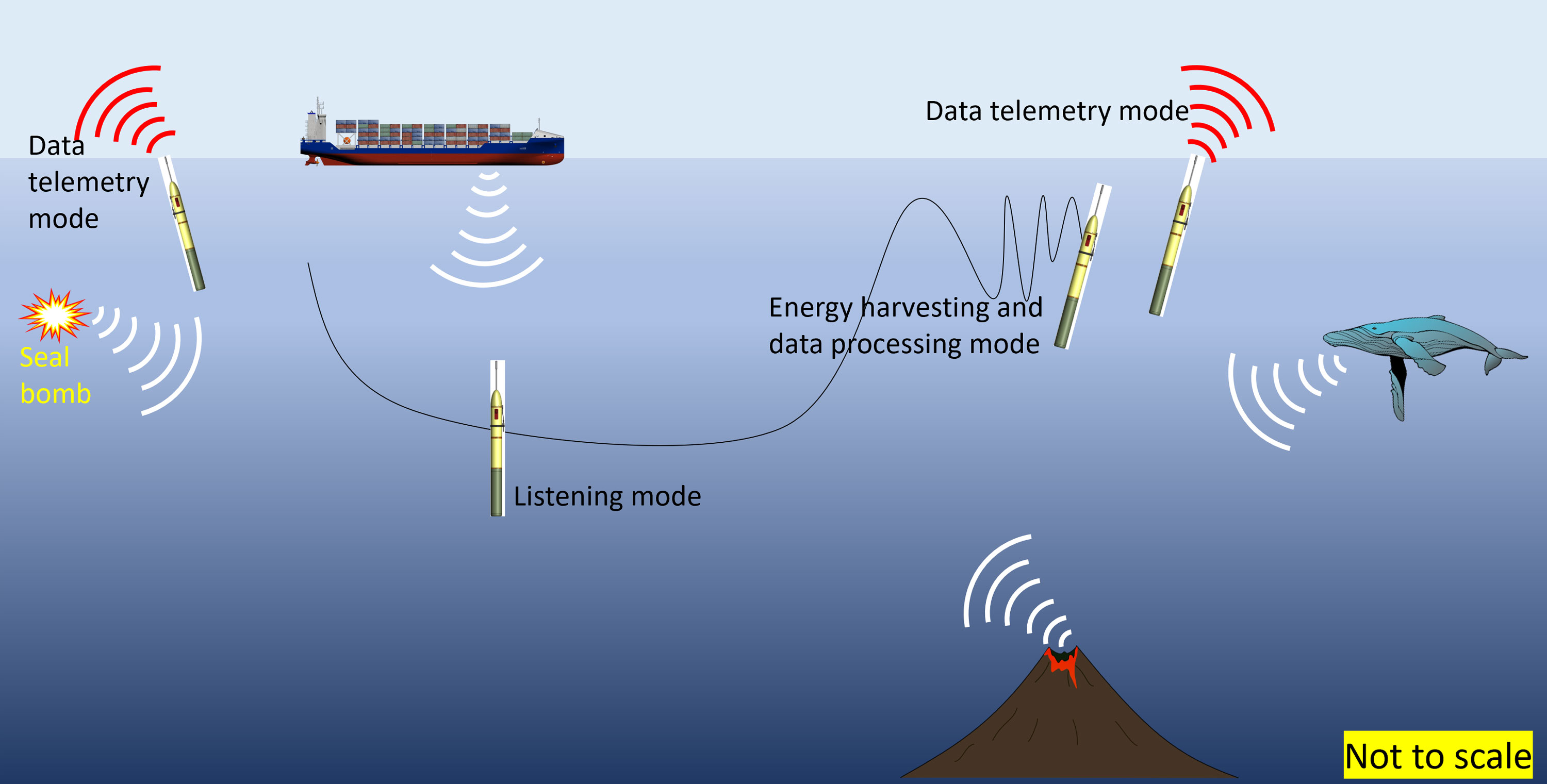
The team prepared the float on shore, transported it to sea on a small fishing boat, and then carefully deployed it by hand. Once deployed, the float began its dive schedule. In total, the float collected 6.9 GB of acoustic data over 54 dives to “parking” depths as deep as approximately 700 meters (2,297 feet). It was at these depths that the float achieved neutral buoyancy, allowing for low system noise data collection, and switched to listening mode. After 30 minutes of data collection, the float began its return to the surface, recharging (using the OTEC system to harvest energy) and stopping to process select “real-time” data into compact data digests along the way. At the surface, the float transmitted its location (GPS position) along with the data digests via the satellite telemetry link to, and received revised instructions as needed from, the team on shore. It then began the next dive->park->listen->ascend/harvest->process->surface->transmit cycle. Each of these cycles lasted approximately eight hours.
During the mission, the team continuously tracked the float’s location (see the map) using the GPS positions it reported. Based on this information, the team was able to easily find and recover the float after the final cycle.

The small fishing boat used to recover the float following its final demonstration off Hawai‘i in 2026 as part of the Autonomous, Directional Acoustic Profiling Float for Soundscape Characterization project. Image courtesy of Michael Zedelmair, Seatrec. Download largest version (jpg, 71 KB).
The Results
The mission was a success and the float operated as anticipated. In fact, it produced slightly more power than it consumed!
Initial analysis of the real-time directional acoustic data collected over the two-week period showed a variability of the noise field, mainly due to directional wind noise. The float has been shipped back to California. Once they receive it, the team will analyze all the raw data to identify the other types of noise detected by the float, such as marine mammals, human-made sounds, or meteorological phenomena. Once this data is retrieved, the team is hoping to deploy the float on an indefinite mission.
As this project comes to a conclusion, the team can confidently say their float can collect deepwater directional acoustic data while generating its own power to do so. With data still to be analyzed and a potential long-term mission to follow, there’s still more to be learned about deepwater soundscapes from this first-of-its-kind technology.